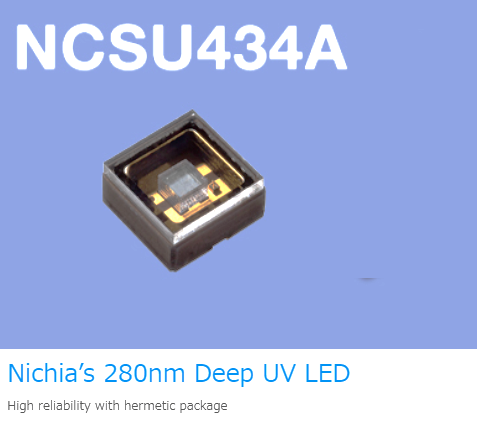
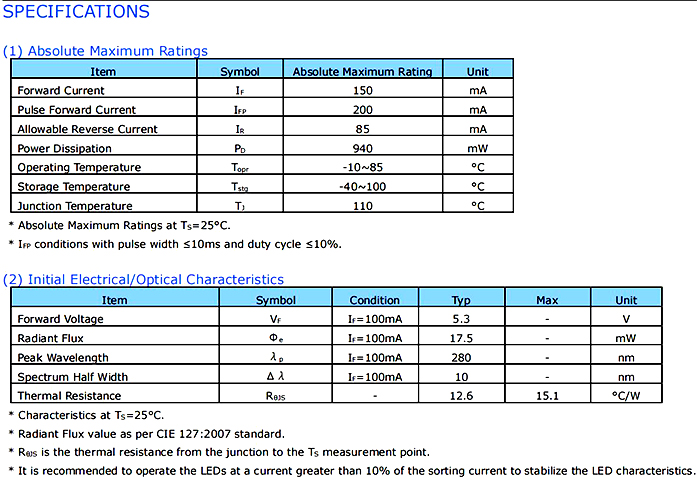
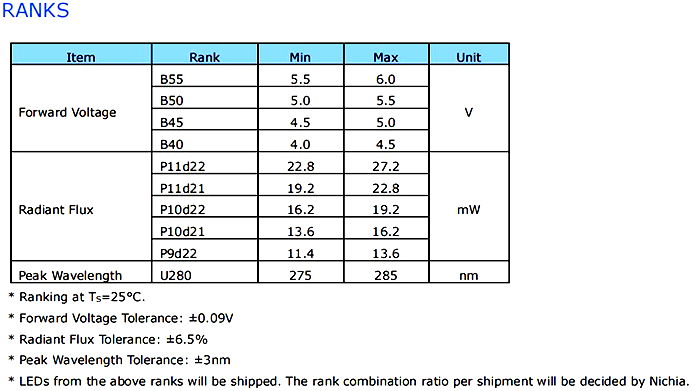
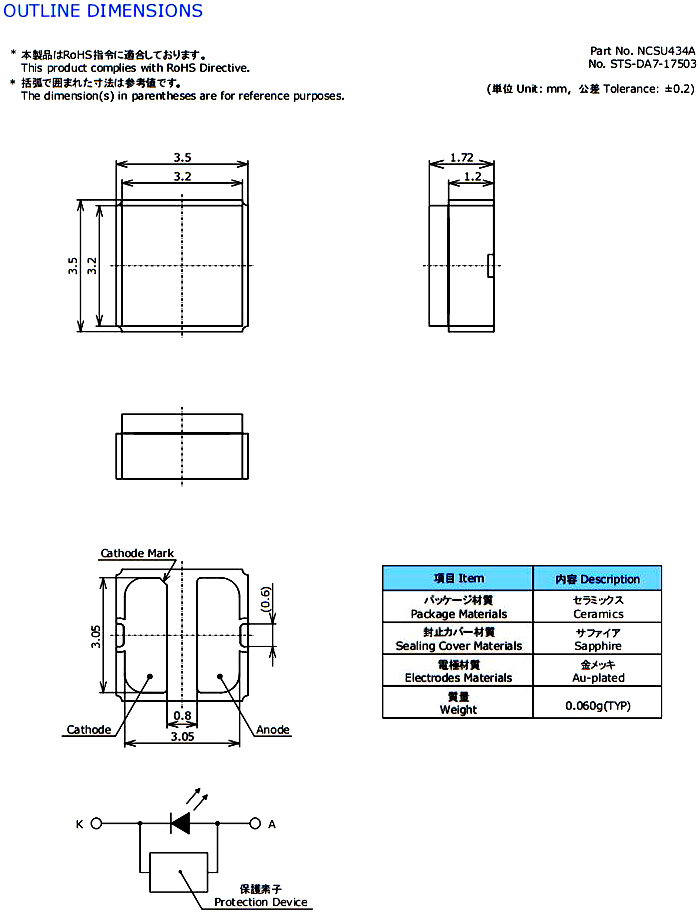
NICHIA Corporation (Headquarters: Anan City, Tokushima; President: Hiroyoshi Ogawa; hereinafter “Nichia”) announces confirmation through experimentation of the inactivation effect (99.99%) of NICHIA’s 280nm deep UV LEDs on the novel coronavirus SARS-CoV-2.
1.Summary of the experimental results
This experiment was carried out by Professor Masako Nomaguchi and Assistant Professor Takaaki Koma of Tokushima University Graduate School of Biomedical Sciences.
Experimental environment (reconstruction) irradiation conditions : irradiation distance 50mm, irradiance 1.7mW/cm2
Experimental results : the inactivation effect of Novel Coronavirus was confirmed to be 99.99% after 30 seconds of deep ultraviolet irradiation.
Irradiation time | Inactivation effect |
30 seconds | 99.99% |
10 seconds | 98.42% |
5 seconds | 93.28% |
Table 1. Inactivation effect by irradiation time (reference values)
The Efficacy Assessment of Disinfecting Substances Alternative to Alcohol for Use Against Severe Acute Respiratory Syndrome Coronavirus 2 (SARS-CoV-2) (Ministry of Economy, Trade and Industry) has judged virucidal efficacy of disinfecting substances against SARS-CoV-2 on the basis of the criterion set at a 99.99% or more reduction in viral titer.
The virucidal effect of handwashing and hand sanitizers, recommended as measures to control infectious diseases, is reported to be
• about 99% when washing hands with running water for 15 seconds
• 99.99% when using commonly-available alcohol-based hand sanitizer (containing 77–81% ethanol) for 30 seconds.
However, to get a better cleaning effect, hands must be thoroughly rubbed when washing with water. When using alcohol disinfection, sufficient amounts of alcohol are required to contact the object being sterilized, which takes time and effort.
According to the experimental results of deep ultraviolet ray, we know that it can easily achieve high sterilization effect in a shorter time.
We found that deep 280nm UVC UV LEDs may have a high virucidal effect while saving time and effort.


2. Virucidal power
Sterilization by deep 280nm Ultraviolet LEDs involves the following two factors:
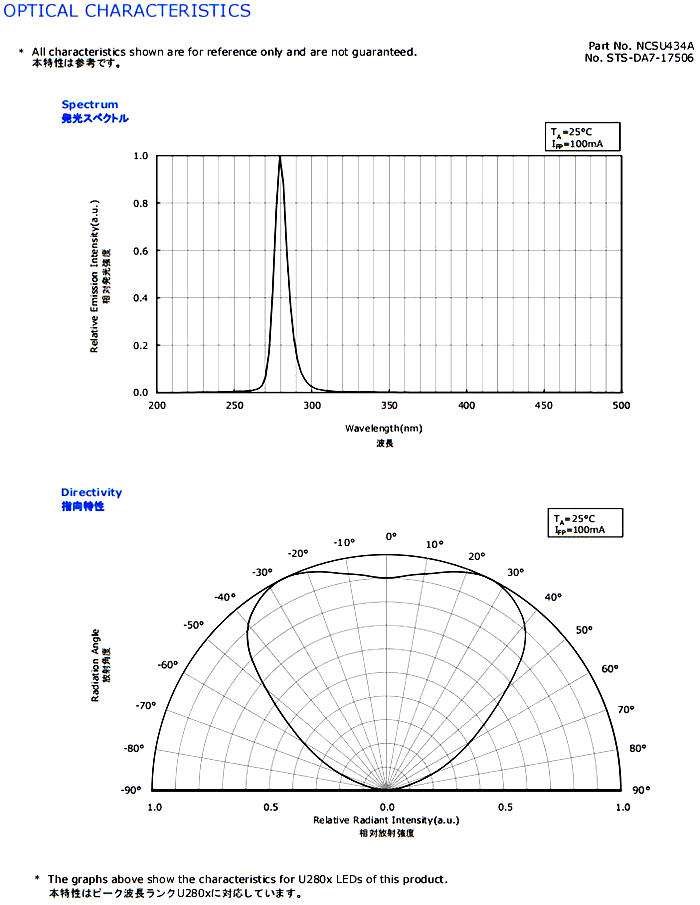
• Wavelength: The difference in the virucidal effect according to wavelength shows that a wavelength of 260 nm exhibits the highest virucidal effect (100%).

• Optical output power: Higher optical output power (radiant flux) of LEDs is favorable.

Sterilization power is obtained by multiplying the virucidal effect according to wavelength by optical output power.

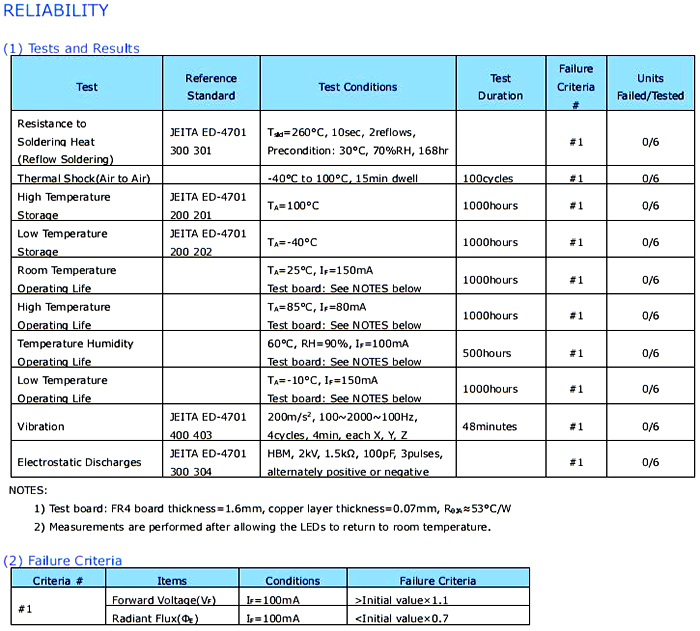
While the life span of the 265nm LED is expected to be approximately 2,000 hours, that of the 280nm LED is expected to be approximately 20,000 hours, or roughly 10 times as long as that of the 265nm LED.
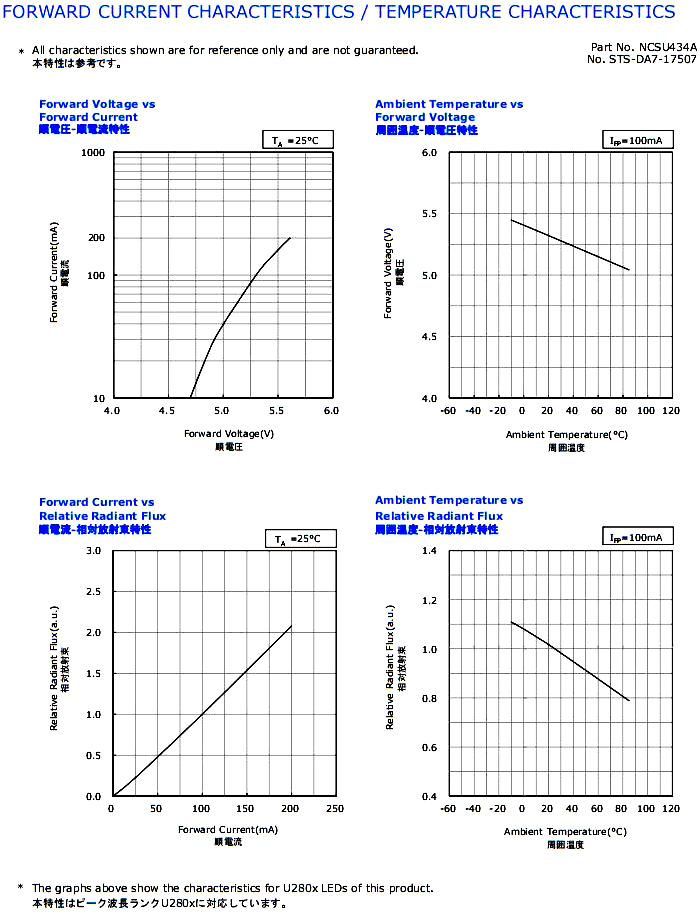
The shorter the wavelength of light emitted from UV LEDs meanslower performance, such as output and lifespan.Therefore, the power conversion efficiency (i.e. wall-plug efficiency or WPE) of the UV LED also declines sharply. Conversely, NICHIA NCSU334B 280nm UVC LEDs can present higher output and longer lifespans.
In addition, the putative life of 280nm is about 20000 hours, while 265nm is estimated to be about 2000 hours, so 280nm is about 10 times longer. Ultraviolet LEDs have the characteristics that : when the wavelength is short, the performance such as light power and life will be reduced, and the photoelectric conversion efficiency will also be very low. This feature results in a high output power of 280nm and long life. Therefore, in consideration of higher bactericidal capacity and longevity, the wavelength of 280nm was adopted for this inactivation experiment.
3.Contribution of pilot products
NICHIA has contributed additional prototype hand-held UV irradiation devices that were made for the inactivation experiment to Tokushima Prefecture (20 units) and Tokushima University (30 units). This rechargeable, portable device can be easily used for sanitizing common spaces and surfaces where alcohol-based solution cannot be used.

NCSU334B |
 6.8x6.8x2.12
|
Wavelength | 280nm |
Radiant flux | 70mW |
Current | 350mA |
Forward voltage | 5.5V |
WPE | 3.6% |
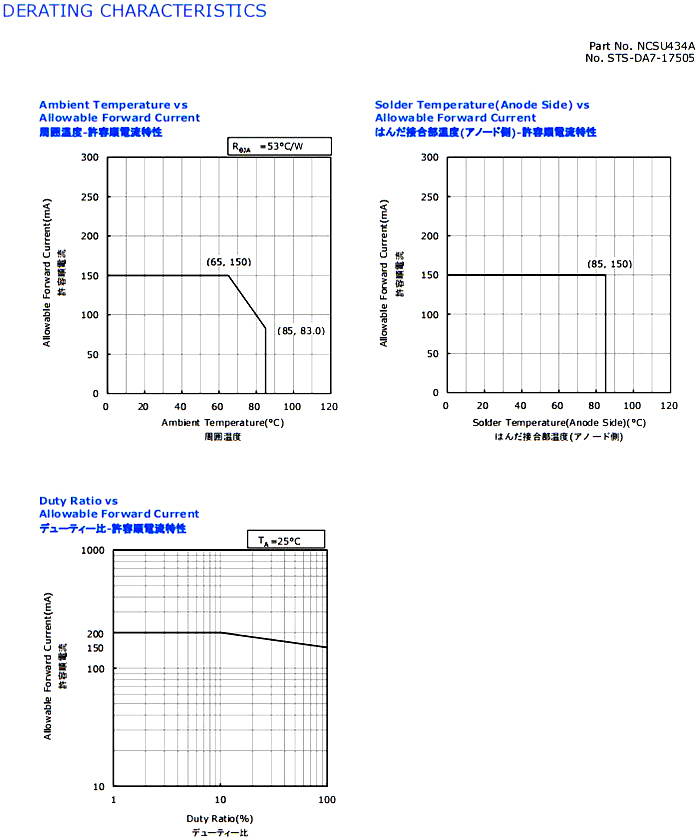
This device is equipped with 12pcs deep 280nm Ultraviolet UV LEDs NCSU334B at intervals of 25 mm These LEDs offer the industry’s highest radiant flux, 70mW (typical value), and WPE, 3.6%, at the peak wavelength of 280nm (typical value) (according to NICHIA research).
NICHIA will continue to devote itself to the development of high power deep ultraviolet LED with stronger bactericidal ability in the future, in order to overcome Novel Coronavirus, and hope that this deep ultraviolet LED is used in all kinds of products, also can bring you some help in daily life.
References
1) The Journal of the Japanese Association for Infectious Diseases, 80:496-500, 2006.
2) J. Antibact. Antifung. Agents, Vol.48, No.9, pp.477-480 (2020).
3) JIS Z8811-1968
4)from NICHIA Corporation News